Why Your Skin Changed in Perimenopause — and What Actually Helps
It didn’t feel gradual. That’s the part nobody prepares you for.
Aging skin is supposed to creep up over decades — a line here, a little less bounce there. But somewhere in your forties, a lot of women look in the mirror and find that something changed fast. Skin that was fine two years ago is suddenly drier, thinner, creased in places it wasn’t. You wonder whether you did something wrong, or stopped doing something right.
You didn’t. What changed wasn’t your routine. It was your estrogen.
The short answer: the acceleration is real and hormonal. Daily broad-spectrum SPF 30 or higher and a well-tolerated retinoid are still the two things with the strongest evidence behind them, and they work at this stage of life too. Dryness is doing more of the work than you think. Give any change three months before judging it.
Everything below explains why — including what the hormone connection does and doesn’t mean for treatment.
Why It Happened This Fast
Estrogen does more for skin than most women are ever told. It supports collagen production, helps skin hold water, and contributes to the thickness and elasticity of the dermis. When estrogen falls through perimenopause and into the years after your final period, all of that changes at once.
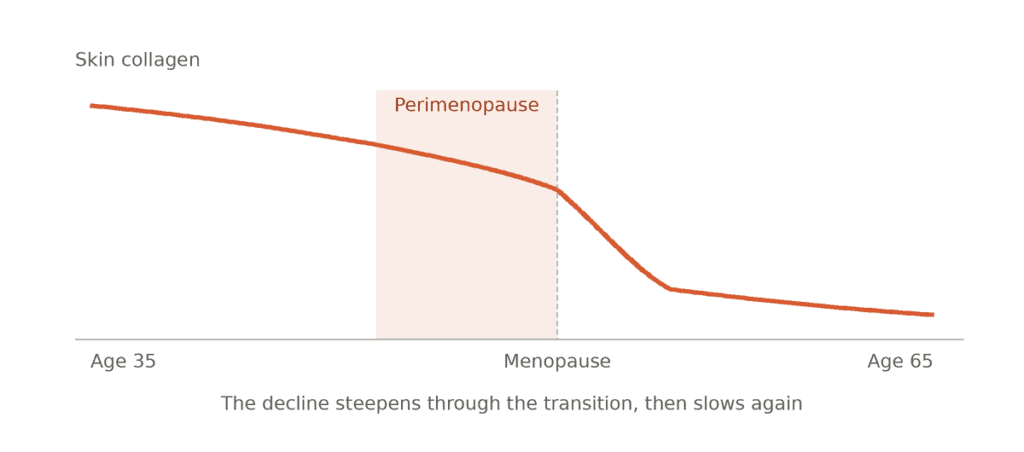
This is why the change feels sudden rather than gradual. Chronological aging is a slow line. The menopause transition puts a step in it.
A word on the numbers, because you will see them quoted everywhere. The widely repeated figures — a large percentage of skin collagen lost in the first few years after menopause, a smaller percentage each year afterward — trace back to observational and histologic work by Brincat and colleagues in the 1980s. That research found something genuinely important: skin collagen content tracks menopausal age rather than chronological age, declining at roughly two percent per postmenopausal year. The direction and the shape of that curve are well supported and have held up.
What deserves more caution is the precision. Those figures come from small studies, and they get repeated across the internet with far more confidence than the original evidence carries. Treat them as the pattern rather than the measurement — your skin is not on a published schedule.
Two practical things follow from this.
Your skin needs more moisture than it used to. Falling estrogen reduces the skin’s ability to retain water and weakens barrier function. That means dryness is a much bigger part of what you’re seeing at this age than it was at thirty — and dryness is the most fixable thing on this list.
Sun damage from earlier decades becomes visible now. The UV exposure of your twenties didn’t show while collagen was plentiful. As the reserve drops, what was underneath surfaces. This is not a reason for regret; it’s a reason for sunscreen, which prevents the next twenty years of the same thing.
If you are not certain whether you are in perimenopause at all, that question is worth settling first — one sign matters far more than the rest of the symptom lists.
Dryness, Fine Lines, or Wrinkles?
Before changing anything, work out what you’re actually looking at. Three different things get called wrinkles, and they respond to completely different treatments. One of them often improves within a couple of weeks with nothing more than a better moisturizer — and it’s the one that becomes far more common in perimenopause.
When dryness is part of the picture
Dry skin shows every line more clearly. Moisturizer works by trapping water in the skin, which can temporarily soften how prominent fine lines look — a point the American Academy of Dermatology makes about moisturizer’s role.
Be precise about what that means. Consistent moisturizing may soften the appearance of fine lines. It won’t remove lines caused by structural change in the skin.
A few honest questions about your own skin will usually tell you whether dryness is involved:
- Do the lines look more noticeable right after cleansing?
- Do they improve after a few days of consistent moisturizing?
- Does your skin feel tight, rough, or flaky?
- Do they vary noticeably from one day to the next?
If the lines fluctuate, worsen after cleansing, and improve with moisturizer, dryness is making them more visible than they need to be. Start there before buying anything active. Given what estrogen loss does to skin hydration, this is worth two weeks of your attention before you spend anything.
On drinking more water: it helps less than the internet implies and more than nothing. A systematic review in Skin Research and Technology found small improvements in skin hydration and reductions in clinical dryness from increased water intake, concentrated in people who weren’t drinking much to begin with — while being clear the underlying evidence is weak and at high risk of bias. If you drink very little, drinking more may genuinely help how your skin looks. If you’re already well hydrated, more water isn’t a wrinkle strategy.
Dynamic lines: only there when you move
These appear when you make an expression and disappear when your face relaxes. Crow’s feet when you smile. The vertical lines between your brows when you concentrate.
They’re caused by muscles contracting under the skin. When you’re younger, skin springs back. As elastin diminishes, it holds the crease slightly longer each time.
This is the stage where prevention does the most work.
Static lines: there at rest
Visible when your face is completely relaxed. These have settled into the deeper layer of skin, and they’re what most people mean by wrinkles. They respond considerably less to topical treatment — not nothing, but expectations matter here, because most marketing implies otherwise.
| Dryness-related | Fine lines | Wrinkles | |
|---|---|---|---|
| Appearance | Surface, variable | Shallow | Deeper, set |
| Day to day | Fluctuates | Consistent | Consistent |
| When visible | Worse when skin is dry | Often on movement | At rest too |
| Responds to | Moisturizing, days to weeks | Topicals, months | Limited topical response |
| Realistic goal | Reduce appearance | Soften, slow progression | Soften slightly |
What Actually Works, Ranked by Evidence
Two of the following have substantially stronger evidence than the rest. That difference matters more than anything else on this page, so the list is ordered by it rather than by popularity.
Nothing here is menopause-specific, and that’s worth saying plainly: the interventions that work at forty-five are the same ones that work at thirty-five. What changes is that the dryness step matters more, and the case for starting sooner rather than later is stronger.
Strongest evidence
Daily broad-spectrum sunscreen, SPF 30 or higher. The highest-return step available, and the one most often skipped. It prevents rather than repairs — but since UV damage is the largest driver of the lines you’re trying to reduce, prevention is most of the work. Every morning, year-round, including near windows.
Retinoids. The most studied topical ingredient for visible aging. They accelerate cell turnover and stimulate collagen production, changing skin structure rather than only its surface appearance, as Harvard Health summarizes.
“Retinoid” covers a family, and the differences matter:
- Retinol — over the counter, gentlest, and the sensible starting point for most people
- Tretinoin — prescription only, with the strongest established evidence for photoaging and fine wrinkles
- Adapalene — available over the counter in the US, but its approved use is acne rather than aging. It isn’t the first choice for fine lines specifically.
One caution specific to this stage: skin that’s drier and thinner tolerates retinoids less easily than it did ten years ago. That’s an argument for starting lower and slower, not for skipping it.
Moderate evidence
Vitamin C — antioxidant defense that supports collagen. Reasonable evidence, modest effect, pairs naturally with morning sunscreen.
Niacinamide — supports barrier function and improves texture over time, and is unusually well tolerated alongside other actives. Barrier support is more valuable now than it was at thirty.
Hyaluronic acid — draws water into the skin. Noticeably improves how dryness-related lines look; smaller and largely temporary effect on structural wrinkles.
Peptides — some evidence for supporting repair and elasticity. Less studied. A nice-to-have.
Temporary or cosmetic
These aren’t scams. They work — for a few hours. That makes them useful before a wedding or a photograph, and not a strategy.
Silicone primer fills uneven texture so foundation doesn’t settle into lines. Silicone tape or patches hold skin still and hydrated while worn; the smoothing typically fades within hours of removal. Facial massage may briefly help circulation and puffiness. Facial icing gives temporary tightening and de-puffing.
Weak or mixed evidence
Most kitchen-cupboard remedies — coconut oil, lemon juice, egg white masks, castor oil. Evidence for reducing wrinkles is weak, and lemon juice in particular can irritate skin and increase sun sensitivity.
“Natural alternative” claims generally. Bakuchiol is marketed as a gentle retinol substitute. It is gentler. It’s also less studied. Gentler is a legitimate reason to choose it; “just as effective” isn’t a supported claim.
The summary
| Intervention | What it does | Evidence | Timeframe |
|---|---|---|---|
| Broad-spectrum SPF 30+ | Prevents further damage | Strong | Ongoing, preventive |
| Retinoids | Turnover + collagen | Strong | 6 weeks–3 months+ |
| Vitamin C | Antioxidant defense | Moderate | 2–3 months |
| Niacinamide | Barrier, texture | Moderate | 4–8 weeks |
| Hyaluronic acid | Hydration | Good for dryness-related lines | Days |
| Peptides | Repair support | Limited | 2–3 months |
| Silicone primer | Cosmetic fill | Immediate, cosmetic | Hours |
| Silicone tape | Cosmetic smoothing | Immediate, cosmetic | Hours |
| Massage / icing | Circulation, puffiness | Thin | Hours |
| Home remedies | — | Weak | — |
What About Estrogen Itself?
If falling estrogen is driving the change, the obvious question is whether replacing it reverses it. You’ll have seen this discussed, and it deserves a straight answer rather than a dodge.
A 2023 systematic review and meta-analysis in the Journal of Menopausal Medicine (Pivazyan and colleagues) concluded that menopausal hormone therapy increases skin elasticity and collagen content, increases skin thickness, and reduces the severity of wrinkles. The mechanism is well understood and the direction of effect is reasonably consistent.
The same review is careful about how much weight that carries. Study results are heterogeneous — at least one trial found no effect on skin collagen at all — and the authors state plainly that more well-conducted clinical trials are needed before the questions can be answered on an evidence basis. This is a real finding, not a settled one.
Here is the part that matters more than the finding.
Skin is not a reason to take HRT, and no reputable body recommends it for that purpose. Menopausal hormone therapy is prescribed for symptoms — vasomotor symptoms, genitourinary symptoms, bone protection — and the decision involves a risk-benefit conversation about your own history that belongs with your doctor. Any skin benefit is a side effect of a treatment taken for other reasons.
So the honest framing is this. If you are already considering HRT for symptoms, skin changes are a legitimate thing to raise in that conversation. If you are not, this is not the argument that should change your mind. Anyone selling you hormone therapy on the strength of your wrinkles has their priorities in the wrong order, and so does any article that leads with it.
Topical estrogen products marketed for facial skin sit in murkier territory — regulation varies, the products differ from prescribed vaginal estrogen, and the evidence base for cosmetic facial use is thinner than the marketing suggests. Ask a doctor rather than a brand.
A note on collagen supplements
This one deserves its own explanation, because the headline answer and the real answer are different — and it’s marketed hardest to exactly the women reading this.
In 2025, researchers published a systematic review and meta-analysis in The American Journal of Medicine covering 23 randomized controlled trials and 1,474 participants. Pooled together, collagen supplements significantly improved skin hydration, elasticity and wrinkles. That’s the finding you’ll see quoted.
Then they did something previous reviews hadn’t. They separated the trials by who funded them.
Studies not funded by pharmaceutical or supplement companies showed no effect on hydration, elasticity or wrinkles. Studies funded by industry showed significant effects on all three. The same pattern held when they filtered by study quality: higher-quality studies showed no significant effect in any category.
That doesn’t prove collagen supplements do nothing. It does mean the positive results come disproportionately from studies paid for by companies selling the product — which is a reason for caution rather than confidence. Whatever the eventual picture, they aren’t a substitute for sunscreen or a retinoid.
If topicals aren’t enough
Topical treatment has a ceiling. If your lines are deeper than a routine can reach, in-office treatments work differently, and some have good evidence behind them. That’s a separate decision, and one worth making with a board-certified dermatologist rather than from an article.
Can You Undo It?
Partly, and the honest answer is worth more than an encouraging one.
You can’t restore the collagen that’s gone, and no topical product will. What you can do is slow what happens next, soften what’s shallow, and fix the part that’s dryness rather than structure — which at this stage of life is a larger share than most women assume.
You can’t undo the sun exposure of your twenties. You can change what the next decade adds to it, and given the slope of that curve, the next decade is where the leverage is.
How to Start a Retinoid Without Irritating Your Skin
Retinoids commonly cause dryness, flaking and irritation in the early weeks. That’s how they behave while skin adjusts, not a sign something has gone wrong. Drier, thinner skin is more reactive, so this matters more now than it would have at thirty.
The common mistake is starting nightly at full strength. Build up by tolerance instead:
Start gentle. Choose an over-the-counter retinol, not the strongest product you can find.
Once or twice a week, at night. A pea-sized amount for the whole face. Moisturize afterward.
Increase by comfort, not calendar. Only go up after your skin has stayed comfortable for several weeks. If it’s irritated, hold where you are or drop back. There’s no schedule to keep up with, and some people never need nightly application at all.
Three things that help:
Buffer if you need to. Moisturizer first, then the retinoid, softens the effect while you adjust.
Wear sunscreen daily. Retinoids increase the skin’s sensitivity to sunlight, and unprotected UV exposure continues causing exactly the damage the routine exists to prevent.
Know the difference between adjusting and reacting. Mild dryness and flaking early on is expected. Persistent burning, significant redness, swelling, or worsening after several weeks is not — stop, and speak to a pharmacist or doctor.
If you are pregnant: avoid retinoid skincare products, including over-the-counter retinol and adapalene. If you are breastfeeding or trying to conceive, check the specific product guidance and speak to your doctor. This is AAD guidance, not caution on our part. Pregnancy remains possible during perimenopause until you have gone twelve months without a period — which is one of the practical differences between perimenopause and menopause.
How Long Does It Take?
Most people see visible improvement in fine lines somewhere between six weeks and three months of consistent use — and almost nobody is told that, which is why so many stop at week three and conclude it didn’t work.
| Timeframe | What to realistically expect |
|---|---|
| Days to 2 weeks | Skin feels better. Dryness-related lines look less obvious. |
| 4–6 weeks | Texture and tone start improving. Fine lines largely unchanged. |
| 6 weeks–3 months | Retinoid effects on fine lines begin showing. |
| 3–6 months | Clearer improvement. Consistency matters more than which product you chose. |
| 6 months+ | The compounding stage. Sun protection’s work is invisible but real. |
Two honest notes. Retinoid benefits require continued use — stopping means gradual return. And no topical routine erases deep static wrinkles. Anything promising that is selling you something.
When Makeup Settles Into Lines
You did everything right in the morning, and by mid-afternoon foundation has gathered in the lines under your eyes and around your mouth. This gets worse as skin gets drier, which is why it may be newly annoying.
Two adjustments help more than any product claim.
Go lighter on coverage. Heavy matte foundation emphasizes texture rather than hiding it — it settles into lines and dries there. A sheerer, hydrating formula reflects light more evenly. Spot-conceal where you need it rather than covering everything.
Use a silicone-based primer. It fills surface texture so foundation glides over lines instead of into them.
Also: a thin layer of moisturizer around the eyes before makeup, applied with a light touch. Tugging that skin makes things worse over time.
A Simple Routine
Nothing complicated, no brand names.
Morning
- Gentle cleanse — or just water
- Vitamin C serum (optional)
- Moisturizer
- Broad-spectrum SPF 30+ — the one to never skip
Evening
- Cleanse
- Retinol, once or twice weekly to start
- Moisturizer
If your skin is sensitive or newly reactive — leave the retinol until later. Build up with niacinamide and a good moisturizer for a month, then introduce it slowly.
If your budget is tight — sunscreen first, then an over-the-counter retinol. Those two do more together than a long routine without them.
If dryness seems to be the issue — moisturize consistently for two weeks before adding anything active. At this stage of life, start here by default.
Common Mistakes
Assuming it’s your fault. It isn’t a routine failure. The acceleration is hormonal, and no amount of diligence at thirty-eight would have prevented it.
Judging a retinoid at three weeks. Give it two to three months. Stopping early is a common reason people conclude retinoids don’t work for them.
Starting several actives at once. Irritated skin doesn’t look younger. One new product at a time, a month apart.
Treating dryness as structural aging. Months of the wrong approach for something a moisturizer helps with in days — and the most common error at this stage specifically.
Buying the thing marketed at menopausal skin. “Menopause skincare” is a positioning strategy more often than a formulation difference. Read the actives, not the packaging.
Changing products every month. Consistency tends to beat novelty. A dull routine followed for a year usually does more than an exciting one followed for three weeks.
What actually helps — the evidence, graded
A free seven-page guide covering hot flashes, night sweats, and mood, with
every option sorted into five honest categories: strong evidence, limited
evidence, comfort rather than treatment, tested and not recommended, and
heavily marketed but poorly supported.
Plus the questions worth asking at your appointment. Print it, or keep it on
your phone.
No spam, and nothing sold. Unsubscribe in one click.
Frequently Asked Questions
Why did my skin change so suddenly in my forties?
Falling estrogen affects collagen production, skin hydration and barrier function at the same time, which is why the change feels like a step rather than a slope. It’s a normal part of the menopause transition, not something you caused.
Does menopause cause wrinkles?
It accelerates their appearance. Sun exposure remains the largest single driver of the damage; the hormonal change is what makes that damage visible faster.
Do fine lines always become wrinkles?
They tend to deepen over time, but the pace varies with genetics and sun exposure. Sun protection and retinoid use can slow it considerably.
At what age do fine lines start?
Often in the twenties or thirties, though it varies widely. Sun exposure influences the timing more than age alone.
How long does retinol take to work on fine lines?
Typically six weeks to three months for visible change, sometimes longer. Benefits require continued use.
Can I reduce fine lines without a retinoid?
Yes, more slowly. Daily sunscreen, vitamin C, niacinamide and consistent moisturizing all help. If you can only do one thing, make it the sunscreen.
Does hormone therapy improve skin?
A 2023 systematic review found that menopausal hormone therapy increases skin collagen content, elasticity and thickness. But results across studies are inconsistent, and no medical body recommends taking it for skin. It is prescribed for symptoms, and any skin benefit is secondary.
The Short Version
The change in your skin was hormonal, not a failure of routine — estrogen supports collagen, hydration and barrier function, and all three shift at once during the menopause transition.
What has strong evidence: daily broad-spectrum SPF 30 or higher, and a retinoid introduced slowly. What has less than you’d think: almost everything else being sold to you, collagen supplements included.
And before you spend anything on actives, spend two weeks on moisturizer. At this stage, more of what you’re seeing is dryness than you probably expect.
Related: why you’re waking at 3am · hot flashes and night sweats